Kiri-Jo Creation myth #2
In the boundless expanse before the Four Directions, there was only Wújí (The Ultimateless), a deep, silent ocean of black Qi and cosmic dust. Above this emptiness spun the Yin-Yang Suns—the Venerable Star of Yang and the Quiet Star of Yin—whose eternal dance generated the first Tàijí (Supreme Ultimate).
From the edge of the known celestial sphere descended the Eight Immortals o the Jade Void, borne on the wings of silent fire. They were the Qūn-lún Council, the stewards of a high, forgotten Emperor, sent to establish a great Jīngchéng (Capital Citadel) on the distant, untamed world of Jù-lì, the Land of Hidden Strength.
Their Supreme Leader was Atem, the August Sovereign, who carried the Tàimìng (Mandate of Heaven). His wisdom was the Tao of the mission. Alongside him stood Hin, the Celestial Chancellor, whose measured breath preserved the balance of the Council.
Atem commanded, “Let this dust be fashioned into a weapon against the Guǐwù (Ghostly Afflictions).”
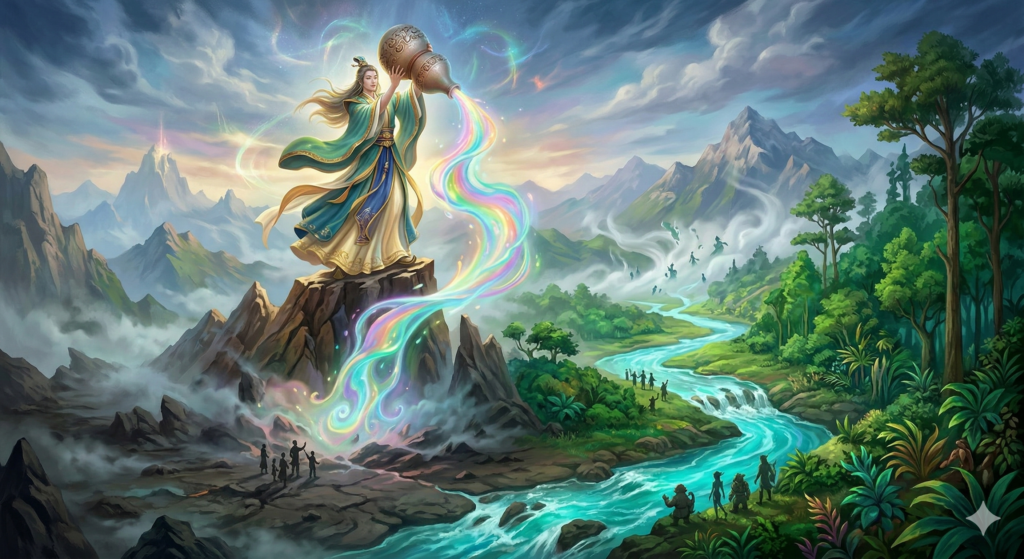
The work was divided among the Immortals:. InYan, the Divine Alchemist, received the command to refine the raw Qi of the planet. Using the Five Elements, InYan brewed the Wànwù Tāng (Soup of Ten Thousand Things), creating the first rivers, the soaring peaks, and the myriad forms of life, including the quick-witted Mín (People), the refined Xiān (Elves), and the sturdy Jiàng (Dwarves). Ahane, the Master Craftsman, was tasked with raising the Tiāntá (Heavenly Terraces), seven immense Pyramids that would channel the Qi of the dual suns. These terraces were meant to contain the power of the ultimate weapon and uphold the stability of the Mandate. However, Jù-lì was corrupted by the presence of the Timatu, the Seven Hungry Demons, a race of devourers born from the ancient imbalance of Qi. The Citadel was meant to be their eternal prison.
To purify the land, Selu and Skan, the Twin Generals of the Celestial Guard, descended with their Jīngbīng (Elite Forces). They carved Jù-lì into the first Fēngdì (Feudal Domains), each one a fortress to maintain order and control over the new populations.
Tawa, the Watchman of the Kiln, stood perpetual guard over the Terraces, ensuring the suns’ Qi flowed without impediment. Masaw, the Shield of the Council, guarded the Inner Chamber, allowing no influence to disrupt the Sovereign’s focus.
For five hundred seasons, the work proceeded. Then, the Great Silence fell from the Jade Void. The connection to the Celestial Emperor was severed. The Qūn-lún Council, the Eight Immortals, were exiles.
Atem, accepting this Tiānmìng (Destiny), declared, “Our purpose is not lost, only redefined. If we cannot return to the Emperor, we shall make our own Heaven here. The Mandate is ours to keep.”
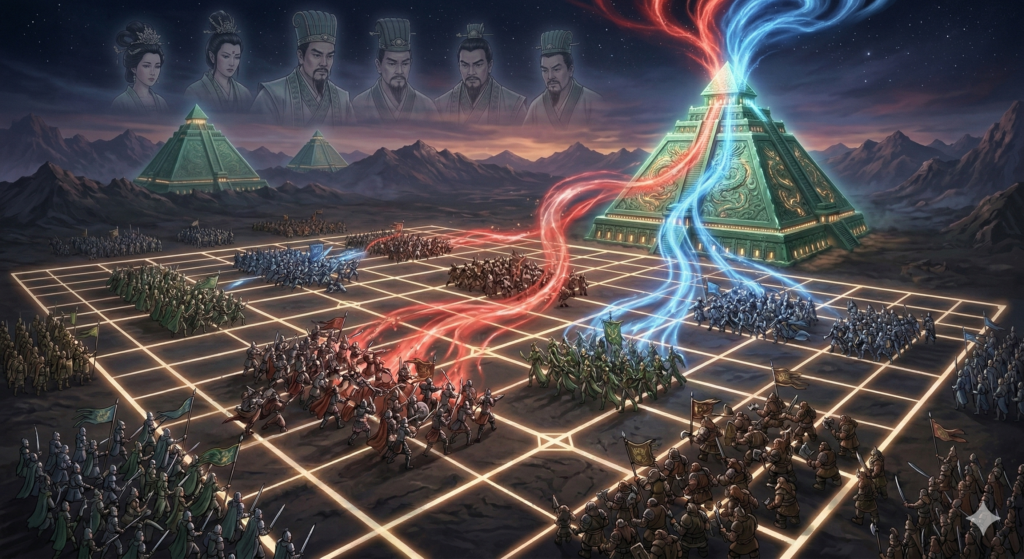
Thus began the Wéiqí Zhīshén (The Divine Game). Atem ordained that the growing Mín, Xiān, and Jiàng were to be the subjects of a perpetual war of strategy. Selu and Skan, through their earthly viceroys and priests, directed the Fēngdì to fight each other in contests of honor, conquest, and virtue.
This eternal struggle is the Secret of the Terraces. The chaotic energy (Huòluàn Qi) of mortal strife is not wasted; it is harvested by the Heavenly Terraces to keep the seals on the Timatu strong. If the People settle into complacent peace, the Qi of the Terraces will dissipate, and the Timatu will awaken to bring the true Huòluàn (Disorder) to the world.
Therefore, the life of the People is a constant, noble struggle, a sacred battlefield where the Mandate of Heaven is earned daily. The Immortals demand not peace, but eternal striving, for the Divine Game is the only Law that holds back the ancient darkness.