
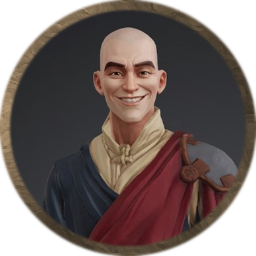
Kato - Human Monk
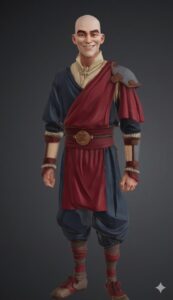
The lithe Varrisian Monk’s calloused hands bear the memory of a thousand performances under the billowing crimson tent of Madame Zora’s Magnificent Traveling Circus. Born to the renowned Flying Nightingales, he first tasted applause at age four when he tumbled through his mother’s outstretched arms in a death-defying leap. Between shows, young Kota would slip away to the menagerie, where he learned to whisper secrets to snarling tigers and feed sugar cubes to temperamental elephants from his flat palm. The beasts recognized something primal in his emerald eyes—a wildness that matched their own.
What distinguished Kota from the common acrobat was his masterful quarter staff, hand-carved from ancient oak and polished with beeswax until it gleamed like amber in the spotlight. With it, he could vault fifteen feet into the air, balance on a tightrope no thicker than a finger, or disarm three knife-wielding clowns in the comedy routine that always closed the show. These performances caught the eye of Master Thorne, who recognized the nascent magical energy flowing through Kota’s veins like quicksilver.
Behind Kota’s dazzling smile and boisterous laughter lies a fortress of solitude. “The crowd sees the peacock feathers,” his father once told him, “never the bird beneath.” This philosophy has carved him into two distinct beings: the showman who can charm coins from misers, and the watchful monk who meditates alone under moonlight. Among his four new companions at the academy, he maintains this division with practiced precision.
Standing a commanding six-foot-two, Kota’s body is a tapestry of lean muscle and subtle scars. His midnight-blue robes, embroidered with silver constellations along the hem, flow around him like water when he moves. His clean-shaven head gleams in sunlight, while his face—angular and sharp-featured—remains equally bare. Those piercing green eyes, flecked with gold near the pupils, miss nothing and reveal less.
Lorem ipsum dolor sit amet, consectetur adipiscing elit. Ut elit tellus, luctus nec ullamcorper mattis, pulvinar dapibus leo.
By age four, he was somersaulting through flaming hoops to thunderous applause, his small body already understanding the language of performance. During daybreak, when the crowds dispersed and performers slept, young Kota would slip between the painted wagons to the menagerie tent, where he’d brush down the midnight-black stallions until their coats gleamed like obsidian. He traveled the continent in his family’s cramped caravan—a wooden home adorned with faded celestial paintings—often riding alongside the weathered animal handlers who taught him to respect the golden-eyed tigers and trumpet-voiced elephants as equals rather than possessions. This reverence for wild creatures became sacred law to him; even now, he approaches every beast with palms open, eyes level, and spine straight—never turning his back on nature’s raw power.
What set Kota apart from the other acrobats was his ancient quarterstaff—hand-carved from rare mountain oak with intricate spiral patterns worn smooth by years of sweat and motion. Under the shimmering spotlight, he transformed this six-foot length of polished wood into an extension of his own body: launching himself twenty feet into the air with a single vault; twirling it so rapidly it became a blur of amber light; balancing it perfectly on one fingertip while performing a one-handed handstand. These mesmerizing displays caught the attention of Master Thorne, who recognized how Kota’s physical discipline could channel the raw magical energies that occasionally manifested as faint blue luminescence along the staff’s length during particularly intense performances. His parents—the legendary Flying Nightingales—along with Madame Zora herself, had been secretly depositing silver and gold coins into an ornate ironbound chest after each successful show, accumulating enough wealth over eighteen years to secure his place at the Academy of Arcane Arts, where he now prepares to weave his physical mastery with the primal forces of Druidic magic.
Kota’s booming laughter fills the academy’s dining hall, his animated gestures drawing eyes from every table while he regales fellow students with tales of circus mishaps. Yet behind his dazzling smile and theatrical winks lurks a fortress of solitude—a wall built brick by brick from his father’s whispered wisdom: “The crowd sees the peacock feathers, never the bird beneath.” During morning meditation, when his four companions attempt conversation, Kota responds with practiced warmth that never quite reaches those forest-green eyes flecked with amber near the pupils. His towering frame—six-foot-two of corded muscle earned from years on the high wire—moves with deliberate grace beneath midnight-blue robes embroidered with silver constellations along the hem. These garments, cut short at the knee and elbow, reveal forearms mapped with thin white scars from catching knives mid-flight. His gleaming shaven head catches sunlight like polished bronze, matching the smooth planes of his angular face where not even stubble dares grow. When he thinks no one watches, his fingers unconsciously trace the worn oak quarterstaff leaning against his chair—the only companion he truly trusts.